

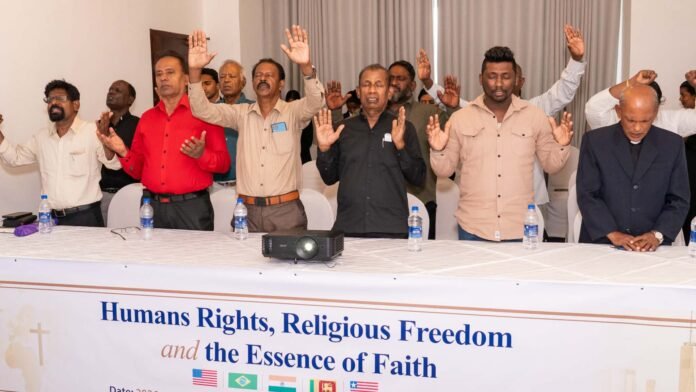

Joint Assembly of Pastors from Five Countries recently held, has echoed challenges Christian’s face and petitioned the Korea Government to constitutionally guarantee religious freedom and the principle of separation of religion and state to be completely reinforced.
The Joint Assembly of Pastors from Five Countries brought together participants from the United States, Sri Lanka, Brazil, India, and Liberia, under the theme “Human Rights, Religious Freedom and the Essence of Faith.”
Their get-together reflected on the challenges facing Christianity present-day, revisit the essence of their faith and explore the future of Christianity and the direction of reform.
They called on the Government of the Republic of Korea to constitutionally guarantee religious freedom and the principle of separation of religion and state to be entirely supported.
However, the issues of human rights and religious freedom, with particular attention to the current issues concerning religion and human rights being raised in the Republic of Korea, were highlighted.
As a result, there are growing calls in the Republic of Korea and parts of the world for the constitutional guarantees of religious freedom and the principle.
Mostly, national rallies opposing legislation concerning the dissolution of religious corporations, along with joint statements issued by religious leaders, have continued.
In recent months, concerns have also been raised by religious and human rights communities both in Korea and abroad regarding investigations and measures taken by government agencies concerning Shincheonji Church of Jesus and Chairman Lee Man-hee.
“This is not an issue concerning any particular denomination or religion alone. It is an issue that concerns all of us: what kind of relationship should exist between the state and religion, and how can we protect the religious freedom and human rights that every faith community rightfully deserves?” the pastors asked, demonstrating commitment to their faith.
The united global pastors historicized the role of the church, saying the Church has served as a refuge of freedom and human rights for those suffering under power and oppression.
“Therefore, in the face of realities where religious freedom and the essence of faith are threatened, we pastors must not remain silent. We must raise our voices for truth and justice,” they said.
“Following the teachings of Jesus, putting freedom, peace, and justice into practice is the sacred mission entrusted to us.” Since the first World Pastors’ Joint Assembly held on August 13, 2026, activities and developments have taken place in various countries as well as on-site events.
At the First Assembly, pastors and religious leaders from various countries around the world came together and raised their voices in support of the shared values of religious freedom and human rights.
Events that have taken place in New York, Chicago, Brazil, India, Sri Lanka, and Liberia were briefly introduced through PowerPoint presentation sharing.
In New York, the United States of America, approximately 60 people attended in person, including 12 religious leaders representing various Christian denominations. The pastors who attended prayed and shared their perspectives together, transcending differences in denomination and background.
All 12 religious leaders personally signed a joint statement calling for the protection of religious freedom and human rights. Meanwhile, one pastor in particular emphasized the importance of unity among pastors, saying, “If even one or two people are not free, then none of us are truly free.”
Following the first session, everyone gathered for a time of prayer and expressed their hope that this meeting would not be a one-time event, but would serve as an opportunity to connect with even more churches and pastors in the future.
For Chicago, United States of America, a total of 111 people attended the First Joint Assembly. In particular, there were continued calls for people to recognize and unite with one another as fellow believers in Christ, transcending differences of race and denomination.
One pastor said, “Events like this are essential because they demonstrate our support for believers around the world, “and expressed his desire to host such an event himself in the future. However, in Brazil, many pastors also joined both online and in person and reflected deeply on religious freedom and human rights. One pastor emphasized that religious freedom is not a privilege granted only to certain individuals, but a fundamental right that must be guaranteed so that everyone can profess their faith without persecution or discrimination. After learning about the situations in different countries around the world, one pastor who attended in-person expressed his commitment to pray and stand in solidarity even more strongly for pastors around the world, saying, “We are stronger when we stand together.”
However, during recent Joint Assembly of Pastors from Five Countries in the New York, six speakers spoke separately. Pastor Marc Thompson of Mattituck Unity Baptist Church in the Bronx, New York, United States of America, delivered the first keynote speech, by reading Amos 4:24 which says, “But let justice roll on like a river, righteousness like a never-failing stream.” He said that the background and meaning of the verse reminds justice should not be occasional or selective, but should continually shape how people, leaders, churches, and communities across the globe work together. “Justice should be upheld and practiced by churches throughout the world,” Pastor Thompson said. “Today, I am saddened as I think about 96-year-old Chairman Lee, who is currently incarcerated, and the concerns that have been raised regarding his treatment and religious freedom. From different parts of the world, many of us are looking at his situation and asking whether justice is being fairly applied.”
In a prayerful tone, he said a” Real Church” would stand up, offer its support, and say, “Enough is enough. Let Chairman Lee go.” He continued that the Bible teaches us that the effective, fervent prayer of a righteous person avails much, and that those who endure must remain faithful to the end, urging the Real Church would stand up and declare that justice must be fairly applied to every religious leader.
No one should be silenced simply because of their faith, the way they pray, or the way they interpret Scripture. Adding that the Real Church in New York, Brazil, Africa, India, and countless other parts of the world would stand together on behalf of Chairman Lee and in defense of religious freedom, and must understand that standing up means taking action. It means doing something constructive to bring about change and help produce a positive outcome in what we believe to be an unjust situation.
Religious freedom must apply even when a person’s beliefs are different from our own or when the situation is taking place far beyond our own neighborhoods. “At 95 years old, he has been incarcerated in South Korea because he believes in Christ.
When I heard his testimony, it changed and touched my heart. It changed my mind and helped me see the signs of the times in which we are living today,” Pastor Lucilla Richards-Seaton of Power, Prayer and Praise Ministries said.
“As God’s people, we have to fight for our religious beliefs, as well as the beliefs of others, including those outside the United States and in other countries. We, as God’s people, have to come together in solidarity, no matter what our differences are in the kingdom.” She publicized urging Christians worldwide, saying “We have to begin to protect our rights and the rights of others” In continuance of the speakers’ action, Pastor Fabricio Leonardo Vasconcelos of the Apostolic Cathedral of the Miracles of Jesus Christ said, “Today, as the pastor of the Apostolic Cathedral of the Miracles of Jesus Christ, I would like to set aside, for a moment, long-standing denominational conflicts to raise an important issue.”
He added that the State should not interfere in religion; yet, what we currently see happening in various parts of the world is the State directly persecuting the church.” In furtherance, the prelate said that the State must ensure that the law and legal procedures are duly observed, rather than using public power to oppress and persecute a church or its leader. He said South Korea is a respected democratic republic, but recently “we have witnessed severe persecution against two churches: the Unification Church and the Shincheonji Church.” For instance, in November 2019, the Shincheonji Church announced that over one hundred thousand people had completed the course at the Zion Christian Mission Center.
This large-scale growth sparked significant persecution from the Korean religious community—leaders who often have ties to the political establishment.
Consequently, in February 2020, when the country’s COVID-19 outbreak was maliciously linked to Shincheonji—creating a storm of controversy—it triggered an intense public backlash. People acted as if the church were to blame for the deaths; this was an absurdity that manipulated public opinion—a situation we understand well, as something similar occurred in Brazil.
A public petition demanding the forced closure of the Shincheonji Church gathered over 500,000 signatures—fueled by outrage over media manipulation regarding the COVID issue—a figure that later surpassed the one-million mark.
Calls for the imprisonment of Chairman Lee Man-hee followed. However, subsequent court rulings demonstrated why public opinion should not supersede judicial judgment. The Supreme Court of the Republic of Korea has upheld the acquittal of Chairman Lee Man-hee regarding charges of violating the Infectious Disease Control and Prevention Act in connection with COVID-19. Currently, Church Chairman Lee Man-hee—at 95 years of age—has been placed in pre-trial detention.
“This occurred before the false accusations against him could even be adjudicated—specifically, the claim that he forced members to join a right-wing party opposed to the left-wing party of Korea’s current president,” he noted. “Today, I speak with a heavy heart about a 95-year-old religious leader in the Republic of Korea who is being held in detention while awaiting trial, without having received a final guilty verdict,” Pastor Subhash Chandra Yadav of the Assembly Builders Church said. “This case raises broader questions about freedom of religion, due process, and human dignity”
” I stand before you today not only as a minister from Sri Lanka. I also stand as a witness to the global challenges facing people of faith. I stand together with others to protect religious freedom in my country and around the world,” Pastor Krishani Asangika Perera, of the Yeshuwa’s Battle Army, said.
“We are living in a serious time. Governments are beginning to become involved in and influence matters of faith.” However, the prelate said that when the protection of religious freedom is weakened by those in power, “I know better than anyone what kind of tragedy can happen next.” “I feel deep sympathy regarding the detention and religious pressure faced by Chairman Lee Man-hee of Shincheonji in South Korea today. On behalf of the global church and pastors around the world, I want to declare our strong solidarity,” the Pastor said. “Looking beyond national borders, the lifelong work of Chairman Lee Man-hee is a great testimony for world peace.” However, Chairman Lee Man-hee, as the Chairman of HWPL, a global peace organization, has travelled around the world tirelessly, dedicating himself to ending war and bringing harmony among people of different religions, and has continued his work even at his old age.
“History has shown us the serious consequences that can arise when state power intervenes excessively in matters of individual conscience and faith,” Pastor Joe D. Kerkulah of God Fellowship International Ministries, Liberia, said.
“When the enforcement of the law and religious freedom come into conflict, an even more careful and balanced judgment is required. I am particularly deeply concerned about the detention of Chairman Lee Man-hee, an elderly religious leader.”
He concomitantly called for serious consideration of the potential impact that prolonged detention in a restrictive environment can have on the health and life of an elderly person. Therefore, he added that if the necessity of detention has not been sufficiently established, including concerns such as flight risk or the possibility of destroying evidence, alternative measures like investigation and trial without detention, or bail, should be actively considered from a humanitarian perspective.
“Nor should anyone face undue pressure or discrimination from the state simply because of their religious beliefs,” the Liberian Prelate said. “Let us overcome the boundaries of denomination, doctrine, nationality, and culture and work together to protect the universal values of human dignity and religious freedom.” The global pastors stated that the Joint Assembly of Pastors from Five Countries will continue with the second, third, fourth, and subsequent assemblies, and expressed their hope that even more pastors will participate in the future.
Global Pastors Call for Korea Constitutional Guarantees on Religious Freedom, Others Joint Assembly of Pastors from Five Countries recently held, has echoed challenges Christian’s face and petitioned the Korea Government to constitutionally guarantees religious freedom and the principle of separation of religion and state to be completely reinforced.
The Joint Assembly of Pastors from Five Countries brought together participants from the United States, Sri Lanka, Brazil, India, and Liberia, under the theme “Human Rights, Religious Freedom and the Essence of Faith.”
Their get-together reflected on the challenges facing Christianity in the present day, revisited the essence of their faith, and explored the future of Christianity and the direction of reform. They called on the Government of the Republic of Korea to constitutionally guarantee religious freedom and the principle of separation of religion and state to be entirely supported.
However, the issues of human rights and religious freedom, with particular attention to the current issues concerning religion and human rights being raised in the Republic of Korea, were highlighted. As a result, there are growing calls in the Republic of Korea and parts of the world for the constitutional guarantees of religious freedom and the principle.
Mostly, national rallies opposing legislation concerning the dissolution of religious corporations, along with joint statements issued by religious leaders, have continued. In recent months, concerns have also been raised by religious and human rights communities both in Korea and abroad regarding investigations and measures taken by government agencies concerning Shincheonji Church of Jesus and Chairman Lee Man-hee.
“This is not an issue concerning any particular denomination or religion alone. It is an issue that concerns all of us: what kind of relationship should exist between the state and religion, and how can we protect the religious freedom and human rights that every faith community rightfully deserves?” the pastors asked, demonstrating commitment to their faith.
The united global pastors historicized the role of the church, saying the Church has served as a refuge of freedom and human rights for those suffering under power and oppression. “Therefore, in the face of realities where religious freedom and the essence of faith are threatened, we pastors must not remain silent. We must raise our voices for truth and justice,” they said.
“Following the teachings of Jesus, putting freedom, peace, and justice into practice is the sacred mission entrusted to us.” Since the first World Pastors’ Joint Assembly held on August 13, 2026, activities and developments have been taken place in various countries as well as on-site events. At the First Assembly, pastors and religious leaders from various countries around the world came together and raised their voices in support of the shared values of religious freedom and human rights.
Events that have taken place in New York, Chicago, Brazil, India, Sri Lanka, and Liberia were briefly introduced through PowerPoint presentation sharing. In New York, the United States of America, approximately 60 people attended in person, including 12 religious leaders representing various Christian denominations.
The pastors who attended prayed and shared their perspectives together, transcending differences in denomination and background. All 12 religious leaders personally signed a joint statement calling for the protection of religious freedom and human rights.
Meanwhile, one pastor in particular emphasized the importance of unity among pastors, saying, “If even one or two people are not free, then none of us are truly free.” Following the first session, everyone gathered for a time of prayer and expressed their hope that this meeting would not be a one-time event, but would serve as an opportunity to connect with even more churches and pastors in the future.
For Chicago, United States of America, a total of 111 people attended the First Joint Assembly. In precise, there were continued calls for people to recognize and unite with one another as fellow believers in Christ, transcending differences of race and denomination.
One pastor said, “Events like this are essential because they demonstrate our support for believers around the world, “and expressed his desire to host such an event himself in the future. However, in Brazil, many pastors also joined both online and in person, reflected deeply on religious freedom and human rights.
One pastor emphasized that religious freedom is not a privilege granted only to certain individuals, but a fundamental right that must be guaranteed so that everyone can profess their faith without persecution or discrimination. After learning about the situations in different countries around the world, one pastor who attended in-person expressed his commitment to pray and stand in solidarity even more strongly for pastors around the world, saying, “We are stronger when we stand together.”
However, during the recent Joint Assembly of Pastors from Five Countries in New York, six speakers spoke separately. Pastor Marc Thompson of Mattituck Unity Baptist Church in the Bronx, New York, United States of America, delivered the first keynote speech by reading Amos 4:24 which says, “But let justice roll on like a river, righteousness like a never-failing stream.”
He said that the background and meaning of the verse reminds justice should not be occasional or selective, but should continually shape how people, leaders, churches, and communities across the globe work together. “Justice should be upheld and practiced by churches throughout the world,” Pastor Thompson said.
“Today, I am saddened as I think about 96-year-old Chairman Lee, who is currently incarcerated, and the concerns that have been raised regarding his treatment and religious freedom. From different parts of the world, many of us are looking at his situation and asking whether justice is being fairly applied.” In a prayerful tone, he said a “Real Church” would stand up, offer its support, and say, “Enough is enough. Let Chairman Lee go.”
He continued that the Bible teaches us that the effective, fervent prayer of a righteous person avails much, and that those who endure must remain faithful to the end, urging the Real Church to stand up and declare that justice must be fairly applied to every religious leader. No one should be silenced simply because of their faith, the way they pray, or the way they interpret Scripture. Adding that the Real Church in New York, Brazil, Africa, India, and countless other parts of the world would stand together on behalf of Chairman Lee and in defense of religious freedom, and must understand that standing up means taking action.
It means doing something constructive to bring about change and help produce a positive outcome in what we believe to be an unjust situation. Religious freedom must apply even when a person’s beliefs are different from our own or when the situation is taking place far beyond our own neighborhoods.
“At 95 years old, he has been incarcerated in South Korea because he believes in Christ. When I heard his testimony, it changed and touched my heart. It changed my mind and helped me see the signs of the times in which we are living today,” Pastor Lucilla Richards-Seaton of Power, Prayer and Praise Ministries said.
“As God’s people, we have to fight for our religious beliefs, as well as the beliefs of others, including those outside the United States and in other countries. We, as God’s people, have to come together in solidarity, no matter what our differences are in the kingdom.”
She publicized urging Christians worldwide, saying “We have to begin to protect our rights and the rights of others” In continuance of the speakers’ action, Pastor Fabricio Leonardo Vasconcelos of the Apostolic Cathedral of the Miracles of Jesus Christ said, “Today, as the pastor of the Apostolic Cathedral of the Miracles of Jesus Christ, I would like to set aside, for a moment, long-standing denominational conflicts to raise an important issue.”
He added that the State should not interfere in religion; yet, what we currently see happening in various parts of the world is the State directly persecuting the church.” In furtherance, the prelate said that the State must ensure that the law and legal procedures are duly observed, rather than using public power to oppress and persecute a church or its leader. He said South Korea is a respected democratic republic, but recently “we have witnessed severe persecution against two churches: the Unification Church and the Shincheonji Church.” For instance, in November 2019, the Shincheonji Church announced that over one hundred thousand people had completed the course at the Zion Christian Mission Center.
This large-scale growth sparked significant persecution from the Korean religious community—leaders who often have ties to the political establishment. Consequently, in February 2020, when the country’s COVID-19 outbreak was maliciously linked to Shincheonji—creating a storm of controversy—it triggered an intense public backlash.
People acted as if the church were to blame for the deaths; this was an absurdity that manipulated public opinion—a situation we understand well, as something similar occurred in Brazil. A public petition demanding the forced closure of the Shincheonji Church gathered over 500,000 signatures—fueled by outrage over media manipulation regarding the COVID issue—a figure that later surpassed the one-million mark. Calls for the imprisonment of Chairman Lee Man-hee followed. However, subsequent court rulings demonstrated why public opinion should not supersede judicial judgment. The Supreme Court of the Republic of Korea has upheld the acquittal of Chairman Lee Man-hee regarding charges of violating the Infectious Disease Control and Prevention Act in connection with COVID-19.
Currently, Church Chairman Lee Man-hee—at 95 years of age—has been placed in pre-trial detention. “This occurred before the false accusations against him could even be adjudicated—specifically, the claim that he forced members to join a right-wing party opposed to the left-wing party of Korea’s current president,” he noted. “Today, I speak with a heavy heart about a 95-year-old religious leader in the Republic of Korea who is being held in detention while awaiting trial, without having received a final guilty verdict,” Pastor Subhash Chandra Yadav of the Assembly Builders Church said. “This case raises broader questions about freedom of religion, due process, and human dignity”
” I stand before you today not only as a minister from Sri Lanka. I also stand as a witness to the global challenges facing people of faith. I stand together with others to protect religious freedom in my country and around the world,” Pastor Krishani Asangika Perera, of the Yeshuwa’s Battle Army, said. “We are living in a serious time. Governments are beginning to become involved in and influence matters of faith.”
However, the prelate said that when the protection of religious freedom is weakened by those in power, “I know better than anyone what kind of tragedy can happen next.” “I feel deep sympathy regarding the detention and religious pressure faced by Chairman Lee Man-hee of Shincheonji in South Korea today. On behalf of the global church and pastors around the world, I want to declare our strong solidarity,” the Pastor informed.
“Looking beyond national borders, the lifelong work of Chairman Lee Man-hee is a great testimony for world peace.” However, Chairman Lee Man-hee as the Chairman of HWPL, a global peace organization, has travelled around the world tirelessly, dedicating himself to ending war and bringing harmony among people of different religions, and has continued his work even at his old age.
“History has shown us the serious consequences that can arise when state power intervenes excessively in matters of individual conscience and faith,” Pastor Joe D. Kerkulah of God Fellowship International Ministries, Liberia, said. “When the enforcement of the law and religious freedom come into conflict, an even more careful and balanced judgment is required. I am particularly deeply concerned about the detention of Chairman Lee Man-hee, an elderly religious leader.”
He concomitantly called for serious consideration of the potential impact that prolonged detention in a restrictive environment can have on the health and life of an elderly person. Therefore, he added that if the necessity of detention has not been sufficiently established, including concerns such as flight risk or the possibility of destroying evidence, alternative measures like investigation and trial without detention, or bail, should be actively considered from a humanitarian perspective.
“Nor should anyone face undue pressure or discrimination from the state simply because of their religious beliefs,” the Liberian Prelate said. “Let us overcome the boundaries of denomination, doctrine, nationality, and culture and work together to protect the universal values of human dignity and religious freedom.”
The global pastors stated that the Joint Assembly of Pastors from five countries will continue with the second, third, fourth, and subsequent assemblies, and expressed their hope that even more pastors will participate in the future.
By: Ojuku S. Kangar, Jr.