

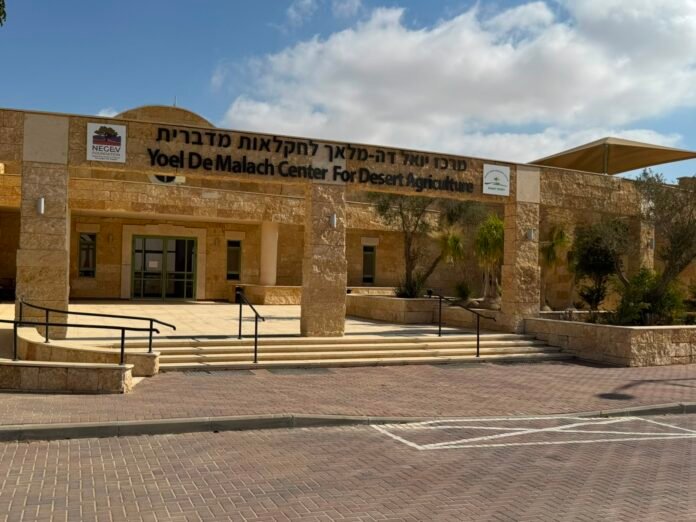

NEGEV DESERT, ISRAEL – In a region where annual rainfall can be measured in millimeters and summer temperatures soar past 40 degrees Celsius, a quiet agricultural revolution is unfolding.
Against all odds, Israel’s Negev Desert, which covers roughly 65% of the country’s landmass, has become a living laboratory for sustainable farming, proving that barren landscapes can bloom when innovation meets determination.
Turning Waste into Wealth:
At the heart of this transformation is a philosophy that treats scarcity as a mother of invention.
The Ramat Negev Desert Agro-Research Center, a premier applied research institute, has spent decades developing practical solutions for agriculture under arid and semi-arid conditions.
Its work spans water management, soil-plant interactions, crop production, and the integration of livestock systems, all designed to function where traditional farming would fail.
One of the center’s most promising breakthroughs is the Pistachio Desert Project.
The project’s multi-disciplinary team designed every activity to utilize each other’s waste as a resource, a true circular economy in action. Solar energy and co-generation power the operation; wastewater is recycled; solid waste becomes compost; and biogas is produced on-site.
The result is not just environmental sustainability, but economic viability. Indigenous medicinal plants, herbs, and spices are processed into high-value cosmetics and other products, offering a path out of poverty for one of Israel’s most vulnerable communities.
“We don’t just teach farming, we teach a mindset,” said Elisha Zurgil, Study Tour International Agri Advisor at Ramat Negev R&D Center.
High-Tech Farming in the Desert
Across the Negev, individual farmers are proving that technology can transform even the harshest environments.
Investment in cutting-edge techniques, especially advanced irrigation. Elisha uses high-pressure drip irrigation systems, delivering water directly to plant roots in precisely measured amounts. This method reduces water usage by 30 to 50 percent compared to traditional sprinkler systems.
His water comes from desalination plants on the Mediterranean coast, and he manually adds all necessary nutrients to the highly pure water to ensure proper crop growth.
His farm grows a diverse range of crops, cherry tomatoes, cucumbers, figs, grapes, lemons, oranges, dates, pomegranates, onions, and about 200 olive trees, protecting him against market fluctuations.
The intense sunlight and dry air actually give him an advantage, allowing natural pest control without heavy reliance on chemicals.
A Global Vision
The impact of Israel’s desert farming expertise extends far beyond its borders.
The Ramat Negev Center operates as part of a regional innovation ecosystem and hosts international training programs for agricultural professionals and students from developing nations, including many from Africa.
In partnership with UNIDO and Israel’s MASHAV agency, Israeli experts are sharing their knowledge of irrigation technologies, water efficiency, and agri-technology with countries like Liberia.