

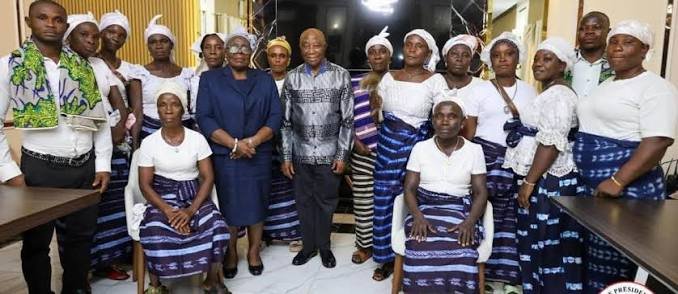

MONROVIA, LIBERIA-A delegation of eminent traditional women from Pleebo Sodoken District in Maryland County on Friday paid a courtesy visit to President Joseph Boakai at his Rehab Office in Paynesville City.
During the visit, the women honored the Liberian Leader and expressed appreciation for what they described as tangible development gains under his administration.
The delegation, led by Cllr. Gloria Musu Scott, former Senator of Maryland County and former Chief Justice of Liberia, commended President Boakai for what it termed as visible improvements in the lives of Liberians, particularly residents of Southeastern Liberia.
The women specifically recognized the improvement of the road network leading to Maryland County, the construction of the Cavalla River Bridge, the upgrading of the Pleebo Health Center, and the deployment of heavy road equipment to support maintenance across the country.
They also applauded the efforts of the government to promote peace and stability through the review of concession agreements and welcomed the reduction in transportation fares by the National Transit Authority (NTA).
Receiving the delegation, President Boakai expressed gratitude for their visit and for the recognition of his administration’s development efforts.
He said he was particularly encouraged that citizens were taking note of developments taking place across the country, emphasizing that the ultimate measure of national progress is the improvement of the lives of ordinary Liberians.
The President noted that the development programs and priorities being pursued by his administration had been on his mind long before he sought the Presidency, adding that he remains encouraged by the progress being made in critical sectors of national development.
President Boakai further stated that the grateful people are always blessed by God, and assured the delegation that he remains focused on advancing the objectives of the ARREST Agenda for Inclusive Development.
The Liberian Leader stressed that national development must translate into tangible improvements in the daily lives of citizens, particularly through better roads, improved health and educational infrastructure, access to essential services, and expanded opportunities to lift Liberians out of poverty.