
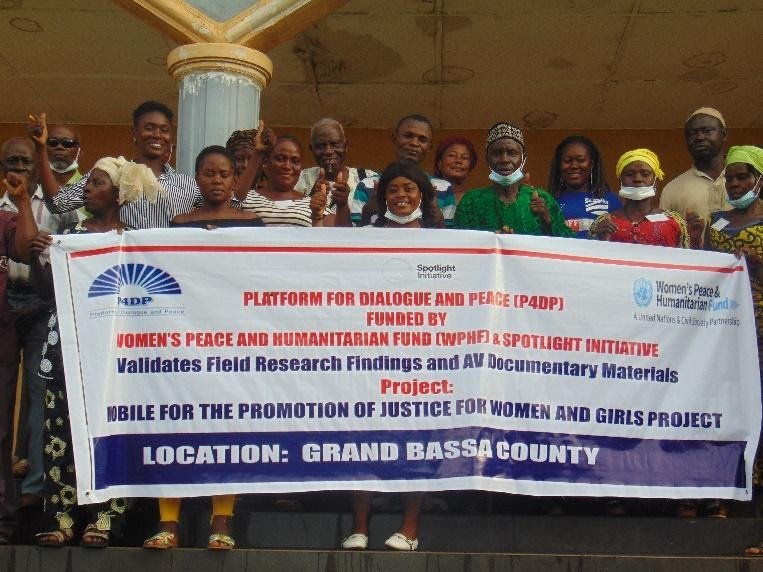

BUCHANAN, GRAND BASSA COUNTY, LIBERIA-The Platform for Dialogue and Peace (P4DP), with a grant from Women Peace and Humanitarian Fund & Spotlight Initiative, through U.N. Women, is currently validating early research findings under the project ‘Mobile for Women’.
The project seeks to contribute to the promotion of Gender-Sensitive Human Rights (GSHR) in Grand Bassa and urban Montserrado County, using Audio-Visual methodology, examines gender and social norms in order to understand the underlying factors contributing to SGBV, and how Liberian women and girls in urban and rural communities experience marginalization.
Because gender norms are social norms, determining what it means to be a woman or man in Liberia, the P4DP study endeavors to unpack entrenched social, cultural practices that are embedded in most formal and informal institutions and produced as well as reproduced through social interactions in society.
Ultimately, the research will produce globally comparable disaggregated data and help to strengthen women’s rights organizations’ capacity in advocacy and evidence-based decision-making activities.
Following a comprehensive Desk review and ‘Listening exercise’ in the field, the organization embarked on a rigorous research process aimed at identifying and documenting the correlation between discriminatory social and cultural norms and gender-based violence.
According to the Gender Officer, the “Listening exercise” provides the research team with the opportunity to examine in detail the perceptions of underprivileged and marginalized women and girls on SGBV, actual and perceived threats, notions of what it means to be a man versus women, options for justice, and the role of both traditional and community leaders in providing justice, specifically for women.
The research also discovered that in most instances, issues affecting women are properly and holistically resolved at statutory courts, even though it is the same sometimes at the community and traditional levels.
However, comparing the ratio, women are said to have redress of the GBV issues through the community and traditional leaderships. Some of the reasons given for this action include the harsh financial burden often placed on them by the police and statutory system of justice, as compared to the community and traditional system of justice.
The four-day validation session was held in Buchanan, Grand Bassa County, in four districts in Compound 1, 3 & 4. Cross-section of stakeholders, including county officials, students, CSOs/CBOs, traditional leaders, members of ‘secret societies’, religious leaders, justice & judiciary and media practitioners, members of the marketing association participated in the sessions.
Based on its commitment to participatory methodology, P4DP Technical Gender Specialist avers that the validation exercise offers a ”civic participatory space” for key stakeholders that were consulted during the initial engagements, to discuss emerging findings and also participate in Audio Visual documentation”.
Generally, participants expressed appreciation for the peacebuilding and research organization for creating forums to allow women and girls in remote towns and villages to freely express their views and experiences on issues affecting them. Also, some female participants were particularly impressed to hear that, in other regions, women are challenging traditional social and cultural norms around masculinity and women and doing what men can do.
Issues ranging from ‘partner beating’, ‘societal perception and role of a woman to that of man’, ‘cash violence and teenage initiation in Sandi practice’, ‘lack of child support’, discriminatory justice system’, ‘unemployment and women subjugation’, etc., are few of the critical issues that dominated some sessions.
At the end of each session, participants thanked P4DP for the sessions and asked that during the awareness sessions P4DP should not stay within urban communities, but should also visit more rural communities to reach the last man and woman in those areas.
The reason for this request is that most men, who are in the act of marginalizing women and girls, are people who mostly refuse to come to any workshop or meeting and for this, the messages do not reach them. Subsequent sessions follow as the team commences validation in Monrovia.