

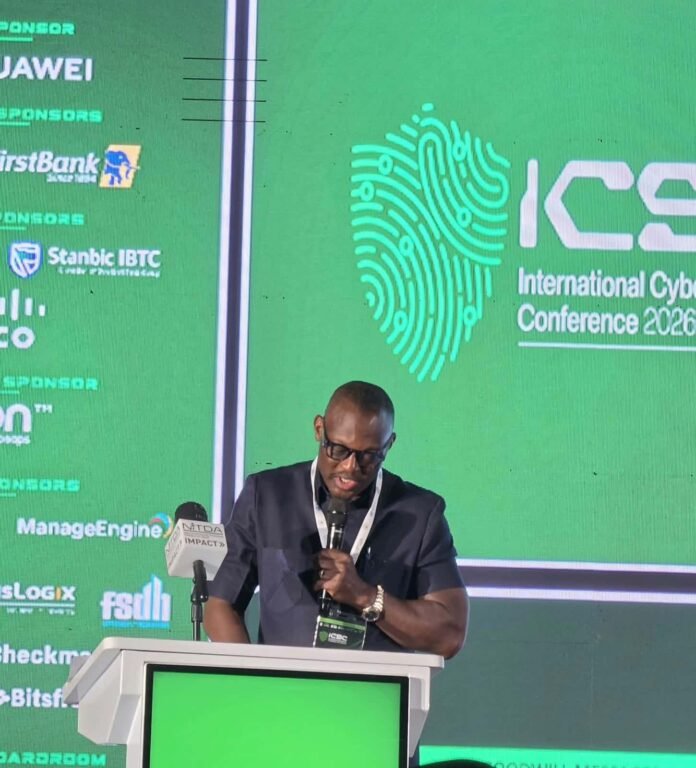

OCTOBER 27, ABUJA, NIGERIA—Liberian Senator Momo Cyrus has called on African governments to fully integrate cybersecurity into their national security strategies, while safeguarding citizens’ fundamental rights.
Senator Cyrus warned that the growing use of artificial intelligence (AI) is creating new threats to national sovereignty, democratic institutions, and public trust.
Senator Cyrus, Chair of the Liberian Senate Committee on National Defense, Intelligence, Security and Veteran Affairs, made the call while delivering a goodwill message at the International Cybersecurity Conference (ICSC) 2026 in Abuja, Nigeria, held under the theme, “Cyber Resilience in the Age of AI: Defending Minds, Networks and Nations.”
He emphasized that cybersecurity must be treated as a core national security priority, requiring coordinated action by governments, security institutions, technology providers, and regional partners.
“Protecting national security and protecting fundamental rights are not competing objectives. Both are essential to the public trust on which effective security depends,” Senator Cyrus stated.
He warned that AI-enabled cyber threats, including fraud, impersonation, disinformation, and attacks on critical infrastructure, are becoming increasingly sophisticated, with potentially serious consequences for public institutions, businesses, and ordinary citizens.
Citing INTERPOL’s African Cyberthreat Assessment Report 2026, the Liberian lawmaker highlighted the growing scale of cybercrime across the continent.
According to the figures referenced in his address, AI is linked to 55 percent of reported cybercrime across Africa, while cybercrime-related losses rose from US$192 million in 2024 to US$484 million. Senator Cyrus cautioned that these developments demand urgent investments in public awareness, digital literacy, institutional preparedness, and effective cybersecurity frameworks.
He urged citizens to verify suspicious messages and requests for sensitive information, while encouraging media organizations and public institutions to strengthen their capacity to identify and counter digital deception.
However, he stressed that efforts to combat disinformation must not become instruments for suppressing legitimate opinions or restricting lawful expression.
“Defending minds must never become an excuse to control legitimate thought or silence lawful expressions,” he said, advocating an approach that empowers citizens to recognize deception and make informed decisions freely.
Cybersecurity as a Pillar of National Security
Addressing the need to protect critical digital infrastructure, Senator Cyrus identified government systems, banking institutions, hospitals, telecommunications networks, schools, and energy infrastructure as essential assets requiring stronger protection against cyberattacks.
He called for improved incident-response capacity, secure data management, tested backup systems, stronger access controls, and effective cooperation between government agencies and private-sector operators.
According to him, cyber resilience is not simply about preventing attacks but also ensuring that institutions can detect threats, respond decisively, restore essential services, and learn from security incidents.
He further urged governments to establish clear accountability mechanisms for protecting sensitive public information, including data handled by private contractors and cloud service providers.
The senator noted that cybersecurity laws and policies must be supported by capable institutions, adequate funding, trained investigators, and justice-sector professionals equipped to handle digital evidence and AI-enabled crime.
Liberia’s Cybersecurity Priorities
Reflecting on Liberia’s efforts to strengthen its cybersecurity framework, Senator Cyrus cited the Cybercrime Act of 2025 and the National Cyber Security Strategy for 2025–2029 as important steps toward improving the country’s legal and policy foundations.
He nevertheless emphasized that legislation alone cannot guarantee cyber resilience without effective implementation, institutional capacity, and appropriate oversight.
As Chair of the Senate Committee responsible for defense, intelligence, security, and veterans’ affairs, he underscored the responsibility of lawmakers to ensure that cybersecurity laws and oversight mechanisms evolve alongside emerging technologies.
He maintained that privacy, freedom of expression, due process, and transparent governance must remain central to cybersecurity policies, insisting that investigative powers should operate within the law and be subject to appropriate oversight.
Call for Stronger African Cooperation
Senator Cyrus called for deeper regional and continental cooperation to strengthen Africa’s collective response to cyber threats, arguing that no country can adequately address the challenges of an increasingly interconnected digital environment in isolation.
He welcomed Nigeria’s role in convening the conference and encouraged Liberia and Nigeria to expand knowledge-sharing, institutional capacity-building, and practical collaboration on cybersecurity.
The senator also highlighted ongoing efforts by the Economic Community of West African States (ECOWAS) to advance cybersecurity information-sharing and develop a regional cybersecurity and cybercrime strategy for 2027–2032.
He highlighted the African Union Convention on Cyber Security and Personal Data Protection and the United Nations Convention against Cybercrime as key frameworks for strengthening cooperation, improving cross-border investigations, and addressing cybercrime while respecting fundamental rights.
Senator Cyrus further encouraged African countries to invest in local expertise, research institutions, cybersecurity professionals, and technology enterprises, stressing that the continent must move beyond being a consumer of externally developed technologies and security solutions.
He outlined five priority areas for action: modern laws and effective oversight; responsible AI governance; sustained investment in skills and public awareness; trusted public-private collaboration; and stronger regional cooperation.
He called for these priorities to translate into practical measures, including faster regional threat notifications, stronger incident-response coordination, improved digital investigation capabilities, and compatible legal frameworks that facilitate legitimate cross-border investigations without undermining constitutional protections.
Balancing Security, Innovation and Human Dignity
Concluding his address, Senator Cyrus emphasized that Africa’s technological advancement must be measured not merely by the sophistication of its machines, but by how effectively technology serves humanity. He argued that protecting digital systems must go hand in hand with preserving the freedoms, dignity, and opportunities those systems are intended to support.
“When we defend minds, we protect the freedom to think and the ability to distinguish truth from deception. When we defend networks, we protect the systems on which livelihoods and essential services depend.
When we defend nations, we protect the institutions, sovereignty, and shared aspirations of our people,” he said.
He called on African governments and institutions to translate political commitments into adequately funded preparedness, stronger institutions, and demonstrable cybersecurity readiness.
Senator Cyrus expressed hope that the conference would strengthen collective resolve to build a digital future in which innovation creates opportunities, security inspires confidence, and regional cooperation turns shared vulnerabilities into collective strength.
His message reinforced a central principle for Africa’s digital future: cybersecurity must be integral to national security, but protecting nations must never come at the expense of citizens’ fundamental rights and freedoms.