

Fellow Liberians, there are moments when the greatness of a government is not measured by the number of buildings it constructs, the foreign dignitaries it receives, or the billions of dollars it announces in its national budget.
Sometimes, the greatness of a government is measured by something much simpler: whether the ordinary citizen feels remembered, recognized, and included in the country’s development agenda.
And today, we have a reason to look closely at one particular proposal in President Joseph Nyuma Boakai’s draft 2027 National Budget: two million United States dollars proposed for the empowerment of commercial motorcyclists in Liberia.
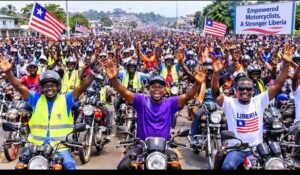
This is a proposal that carries a powerful message about inclusion, economic recognition, and the importance of ordinary Liberians in the national development process. President Boakai certainly deserves commendation for bringing this important segment of our population into sharper focus.
Think about the thousands of young Liberians who wake up before sunrise, mount their motorcycles, and head into the streets in search of their daily bread.
They brave the scorching sun. They endure heavy rainfall. They navigate difficult roads. They transport students, workers, traders, patients, and other members of our society. For many of them, commercial motorcycling is not a luxury. It is their livelihood. It is how they pay school fees, provide food for their families, and survive in an economy where formal employment remains a challenge.
Yet, for years, the national conversation about commercial motorcyclists has largely revolved around traffic congestion, road accidents, restrictions, and law enforcement. Those concerns are legitimate.
Road safety must be protected, and traffic regulations must be respected. But there is another side to this conversation. These motorcyclists are not simply road users. They are workers, breadwinners, young entrepreneurs, and contributors to Liberia’s informal economy.
They deserve to be treated as people whose welfare matters, and that is why the proposed two-million-dollar intervention deserves attention.
What makes this proposal particularly important is the population it seeks to reach. It is easy for governments to concentrate development spending on major institutions, large infrastructure projects, and established economic interests. But development must also reach ordinary Liberians.
It must reach the young man struggling to make an honest living on a motorcycle or tricycle. It must reach the woman selling at the market. It must reach the small business owner trying to keep a family afloat.
It must reach people whose contributions sustain the everyday economy, even when their names rarely appear in the corridors of power.
The Boakai administration is now proposing a specific two-million-dollar empowerment program for commercial motorcyclists, initially focusing on the establishment of designated rest stops at strategic locations.
That is, no doubt, an important step because it suggests that government engagement with motorcyclists should go beyond regulation and enforcement. It should also involve investment, welfare, and economic opportunity. And that is absolutely a conversation worth encouraging.
Imagine commercial motorcyclists in Monrovia, Ganta, Buchanan, Gbarnga, Zwedru, and Harper having access to properly managed facilities where they can rest, access basic amenities, and receive safety education.
That would be meaningful progress. It would demonstrate that the government’s policy can improve the everyday working conditions of people who contribute to the national economy.
If commercial motorcyclists can receive this level of policy attention, other vulnerable groups operating within Liberia’s informal economy will definitely receive structured consideration in the shortest possible time.
Indeed, the Boakai-Koung administration has resolved that development must be inclusive, broad-based, and felt by ordinary people too.
Fellow Liberians, at the end of the day, the proposed two million dollars may appear modest when compared with the entire national budget. But its significance cannot be measured by its size alone. Its significance lies in the people it seeks to reach.
It lies in the young man who struggles every day to provide for his family. It lies in the commercial motorcyclist who contributes to transportation and commerce but often works under difficult conditions.
It lies in the recognition that these citizens, too, deserve a place in Liberia’s development story.
Ladies and gentlemen, history does not remember governments merely for the budgets they present. History remembers governments for the lives they changed, the opportunities they created, and the people they refused to leave behind.
A commercial motorcyclist may not sit in the boardroom of a major corporation. He may not occupy a government office. He may not command the attention of the political establishment.
But he is a Liberian, and in the proposed 2027 National Budget, his welfare has been given a place. This is worth celebrating, and this is worth encouraging. Without a doubt, this is the kind of inclusive development Liberia must continue to pursue.
*This has been an ELBC commentary. A production of the Public Affairs Department of the Liberia Broadcasting System.