

Prez. BOAKAI CALLS FOR CLIMATE JUSTICE, REMINDS WORLD OF LIBERIA’S ENVIRONMENTAL CONTRIBUTION
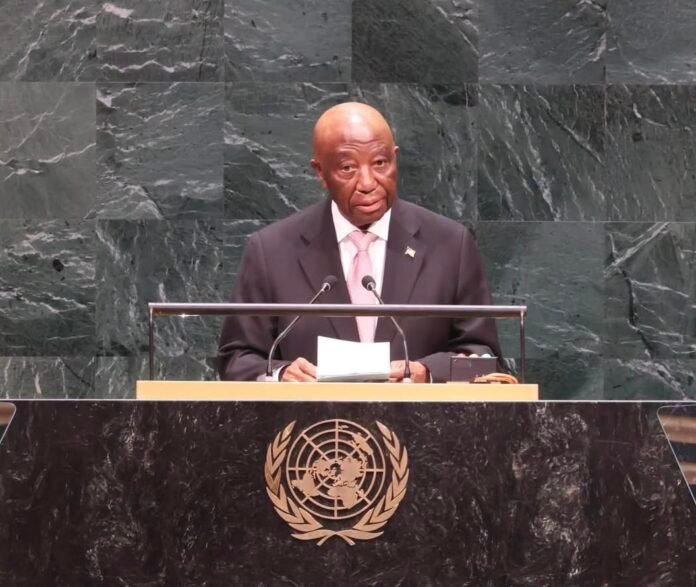
NEW YORK, September 24, 2026 — President Joseph Nyuma Boakai, Sr. has used Liberia’s address to the 81st United Nations General Assembly to remind world leaders that while Liberia contributes virtually nothing to global greenhouse gas emissions, the country is already bearing the consequences of climate change.
Addressing the General Debate at United Nations Headquarters in New York, President Boakai pointed to coastal erosion, flooding and disruptions to agricultural cycles as growing challenges facing Liberian communities.
He also highlighted Liberia’s contribution to the global environmental system, noting that the country harbors 42 percent of the remaining Upper Guinean Rainforest, a major carbon sink whose preservation has significance beyond Liberia’s borders.
“Liberia contributes virtually nothing to global emissions, yet our communities face coastal erosion, flooding, and disrupted agricultural cycles,” President Boakai told the Assembly.
The President said Liberia’s stewardship of its forests represents a contribution to the broader fight against climate change and argued that climate responsibility must therefore be accompanied by climate justice.
President Boakai called on industrialized nations to honor their climate-financing commitments and to operationalize mechanisms addressing loss and damage suffered by vulnerable countries.
His message places Liberia’s climate concerns within a broader international debate over how the costs of climate change should be shared, particularly for countries whose historical contribution to global emissions is comparatively small.
Liberia’s environmental significance is also reflected in national conservation and climate-finance efforts. Government policy has increasingly focused on forests, carbon markets and mechanisms that could channel resources into conservation and climate-resilient development. The government established the Liberia Carbon Markets Authority as part of efforts to develop the country’s participation in global carbon markets.
The 42-percent figure cited by President Boakai is also reflected in Liberia’s environmental documentation, which identifies the country as containing the largest remaining proportion of the Upper Guinea Forest region.
For Liberia, President Boakai’s message at the UN was therefore not only about the impacts of climate change at home, but about the value of what the country continues to preserve for the wider world.
The President’s call comes as Liberia serves a two-year term on the United Nations Security Council, giving the country an additional platform to place issues affecting vulnerable states including climate, peace and sustainable development at the center of international discussions.
At the heart of the message delivered in New York was a simple proposition: Liberia is contributing to a global environmental public good, while its own communities are confronting the consequences of a crisis they contributed little to create.
President Boakai is asking the international community to respond not only with recognition, but with the financing and support necessary to help Liberia protect its people and continue protecting its natural resources for generations to come.