


For Annie Jerrue, the first female president of the National Union of Community Forestry Development Committees (NUCFDC), the Voluntary Partnership Agreement (VPA) between Liberia and the EU on illegal logging did more than talk about forests. It changed who got to talk in the room.
“The VPA helped us a lot,” she says. “It encouraged the women because — due to diverse cultural barriers in some areas — women could not stand among men to talk. When they called for meetings, only men would go there while the women were in the kitchen cooking. But when the VPA arrived, we were told that women are important in all discussions.”
Forest sector specialists say the VPA has led to measurable improvements in women’s participation in forest governance. But they fear these gains are now under threat, as the EU has notified Liberia that it will terminate the legally-binding VPA in mid-2027, and replace it with a non-binding partnership.
TRAINING WOMEN TO BE FOREST LEADERS
The VPA is a kind of trade deal intended to support Liberia’s efforts to address deforestation and prevent illegal timber and timber products from entering the European Union, while promoting sustainable forest management and benefits for local communities. Liberia and the EU signed the VPA in July 2011, and it came into force in 2013.
This started a years-long process through which Liberia, with EU support, worked to implement the systems detailed in the VPA.
Harrison Karnwea, a former managing director and board chair of Liberia’s Forestry Development Authority, says the VPA fundamentally changed forest governance by strengthening the legal framework and its enforcement, and by putting women in leadership roles.
“The laws were there, but they were broken,” he says. “The VPA added some flesh to the bones.”
Before the VPA, women’s participation in forest governance was low, or in some areas non-existent. But the VPA did not immediately change the narrative.
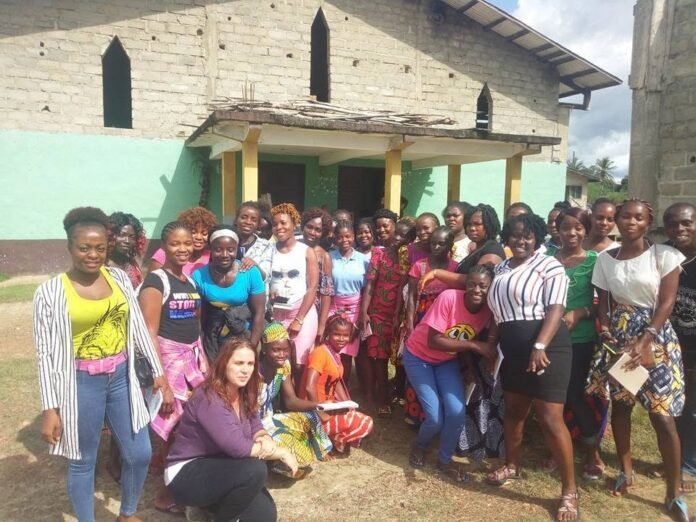
It took years of awareness-raising and intensive training in communities across the country. From 2017 to 2025, civil society organizations supported through the VPA process trained over 100 women, including in Bong, Grand Gedeh and River Gee counties.
“We made them understand that they have an important role to play in the management of natural resources in Liberia — their inclusion adds value to natural resource management,” says Andrew Y. Y. Zelemen, the head of the NUCFDC’s secretariat.
In each location, local facilitators were trained to continue the work after the main project ended. Zelemen says follow-up mentoring was also provided to help new women leaders navigate committee responsibilities.
The NUFCDC’s records show that, in 2021, women held only 52 of the 230 leadership positions in community forests — or less than one quarter. Today, 68 women occupy close to one third of these positions. In relative terms, women’s representation increased by 30.7% since 2021.
“Women are ascending to leadership positions within the community governance structures,” says Jonathan W. Yiah, who leads the Forest Governance Program at the Sustainable Development Institute (SDI). “These are things we never heard of before, but it is happening now.”
Julie Weah, a women’s rights activist and former Executive Director of the Foundation for Community Initiatives, praises the training women received. She says that by including topics such as leadership, forest governance, negotiation and representation, the training helped women to better understand decision-making at the community level.
She says the negotiation component was particularly important because it prepared women to speak with government and company representatives, adding that many women had never been in a formal negotiation before the VPA and that the training gave them confidence and language to defend community interests.
BYLAWS, CONSTITUTIONS & LAW REFORM
The VPA also strengthened the rules governing women’s participation, both in national law and in bodies overseeing community forests. An example is the Land Rights Act of 2018, which strengthened community authority over forest areas and called for equal representation of women, men and youth in decision-making.
Before the Land Rights Act, married women had some land rights defined in the 2003 Inheritance Law, which granted them just a third of their husband’s property after death, but gave them no land rights outside of inheritance. Unmarried women, meanwhile, were not able to own land privately or collectively. The Land Rights Act is the first Liberian law to address this gap, giving all women the right to own land.
“By virtue of the Land Rights Act, the government has practically transferred land ownership to the people who live on the land,” says Harrison Karnwea, the former head of the Forestry Development Authority. “So, if women are in leadership, then they definitely have influence.”
In the case of community forests, the NUCFDC revised its guidelines to require at least 30% women’s representation in Community Forestry Development Committees (CFDCs) — going beyond the requirement in the Forestry Development Authority’s Ten Core Regulations for only “at least one woman”.
“Some of the CFDCs never had even a single woman,” says Zelemen of the NUCFDC Secretariat. “But after the VPA intervention, all of the CFDCs have not less than 30% women’s representation in the governance structure – some are beyond 50%. In fact, some CFDCs are chaired by women.”
But various barriers still limit women’s full participation in natural resource management. Domestic responsibilities often mean women cannot attend long meetings far from home, while costs limit their ability to travel for training or leadership roles. These barriers vary from place to place because of differences in customary practices, particularly between matriarchal and patriarchal systems.
“Some of the barriers have been reduced, although not 100%,” says Zelemen. “The domestic care, cultural, and financial barriers will take time because there are still challenges.”
CONCERNS ABOUT VPA ENDING
Despite the VPA’s gains, its implementation never reached the intended milestone of establishing a system to guarantee the legality of timber throughout the supply chain. This led the EU to propose terminating the VPA and replacing it with a non-binding Forest Partnership. On 17 June 2026, the European Parliament adopted the EU’s proposal. The VPA will formally end in July 2027, by which time the EU and Liberia aim to have negotiated their new Forest Partnership.
But in Liberia there are concerns about what the Forest Partnership will bring — and what it could take away.
Jonathan Yiah worries that the platforms that are giving women voice, including CFDCs and the NUCFDC, will not be maintained financially, saying: “If the VPA leaves and nothing is done, it will affect their strides for gender mainstreaming or participation in forest governance structures.”
For Julie Weah, the solution is for Liberia to institutionalize gender mainstreaming instead of relying on donor-funded projects or programs. She argues that gender should be built into national budgets and government structures, not treated as a project activity. And while she recognizes the gains that the VPA enabled, she says there is still much more to do.
“The program did not get women to where they wanted women to be, but also women are not where they used to be,” she says. “In the beginning, we never saw women anywhere discussing forestry issues, but now they are represented on all bodies.”
Karnwea, the former head of the Forest Development Authority, says the VPA has laid a foundation that should not be lost with the transition to a Forest Partnership. He urges the Liberian government and the EU to preserve the legal, training and gender gains or risk losing a decade of progress.
For its part, the EU’s resolution on terminating and replacing the VPA calls on the European Commission to develop a roadmap setting out the objectives, targets, negotiation timeline, governance structure and inclusive stakeholder consultation arrangements for future cooperation with Liberia in a Forest Partnership, “to ensure that the progress already achieved in stakeholder participation, benefit-sharing and legal reform is not lost”.
It also calls on the European Commission to guarantee “adequate funding and customised capacity-building initiatives” to enable civil society organisations, Indigenous people and local communities to actively participate in any future Forest Partnership.
NUCFDC president Annie Jerrue, who also serves as chair of the CFDC in Rivercess County, is less concerned about the name and status of the new partnership with the EU than about its focus.
“The VPA understands community development,” she says. “So, if the Forest Partnership comes and puts the community first, as the VPA has been doing, then I won’t miss the VPA. But if they forget about the community and focus on government institutions or those based in Monrovia, then surely I will miss the VPA.”
This story was produced with support from Internews’ Earth Journalism Network