
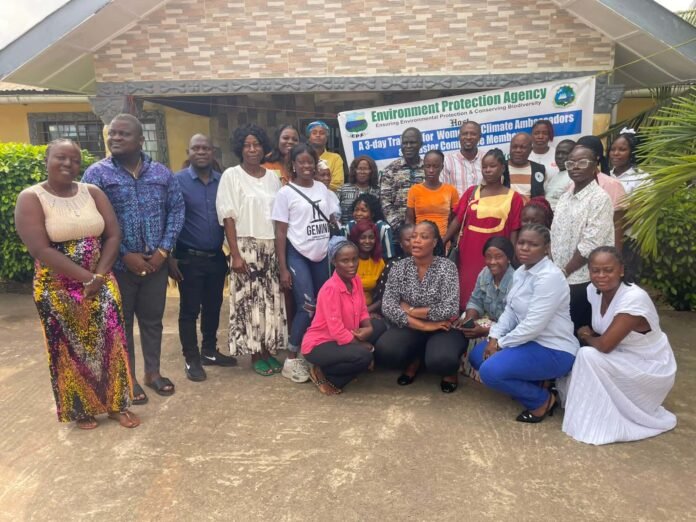

GRAND BASSA COUNTY- The Environmental Protection Agency (EPA), through the Enhancing Climate Information for Resilient Development Project in Liberia (Liberia CIS), has trained and certificated more than forty (40) women across Grand Bassa County as Climate Ambassadors and Disaster Committee Members.
The training aims to enhance community resilience by empowering women as key conduits for climate information dissemination and as active participants in local disaster governance, thereby ensuring inclusive and effective climate adaptation and disaster risk reduction.
The three days initiative which commenced Wednesday, January 28-30, 2026, was hosted under the theme “Empowering women for climate Resilience and Disaster Risk Reduction.” It brought together key government officials including the Executive Director of the Environmental Protection Agency (EPA), Dr. Emmanuel Urey-Yarkpawolo, Grand Bassa County Superintendent, Karyou Johnson, including the Agriculture and Gender Coordinators of the county.
Others include members of the disabled community, youth and students representatives, religious community, and women organizations among others.
Welcoming both participants and organizers, Grand Bassa County Superintendent Karyou Johnson thanked the Environmental Protection Agency (EPA), and its partners for providing such initiative for women in Grand Bassa County.
Superintendent Johnson pledged the local authorities of Bassa strong commitment to continue collaborating with the EPA and the CIS Project Team to ensure residents of the county receive first-hand information on climate and disaster risks management.
He encouraged participants to make full use of the knowledge gained, and called on the women of the county to see such opportunity as their moment of making significant impact to Liberia.
As the implementing institution, EPA Executive Director Dr. Emmanuel Urey-Yarkpawolo during his opening remarks re-echoed the serious effects of climate change currently impacting Liberia.
Dr. Yarkpawolo highlighted heavy rainfall, flooding, coastal erosion, and unpredictable farming seasons as major threats to lives and livelihoods across the country.
“Climate change is no longer a theory or a distant warning. It is our daily reality. We see it in heavier rains and flooding, in coastal erosion along our shores, in unpredictable farming seasons, and in disasters that strike harder and faster than before.”
He also stressed that while women and other vulnerable groups are often the most affected by climate impacts, they also play a vital role in protecting families and strengthening community resilience.
The EPA Boss at the same time described the workshop as part of long-term plan to build a national network of Women Climate Ambassadors, aimed at improving early warning communication, strengthening local leadership, and building a more resilient Liberia.
During the workshop, CIS Project Manager, Nelson Jallah, emphasized the importance of the project and highlighted the critical role women play in spreading climate information to wider audiences.
Mr. Jallah noted that when women are equipped with the right knowledge, they can effectively help communities prepare for and respond to climate related-risks.
“You women play a vital role in ensuring that this project reaches its targeted community and that is while we have come to train you to become climate ambassadors in this part of the country.”
The Enhancing Climate Information System for Resilient Development in Liberia (Liberia CIS) Project is a 5-year, 11.4 Million US Dollars initiative funded by the Green Climate Fund, the African Development Bank, and the Government of Liberia.
The project aims to strengthen Liberia’s capacity to manage climate risks by building a Multi-Hazard Impact-Based Forecasting and Early Warning System (MH-IBF-EWS) in Liberia.
At the training, participants were trained on climate risks, early warning systems, and disaster preparedness and response strategies. They were also encouraged to take active role in local Disaster Management Committees to ensure climate and early warning information reaches communities at the grassroots level.
For their parts, participants described the initiative as an eye-opener for them. They expressed gratitude to EPA and CIS Project Team including their partners for such a project, which they believe will buttress government’s efforts at providing accurate climate and whether data to the country.
They are however, appealing to the EPA and the CIS Team to ensure that the training is regular and regional, rallying the project to provide materials that will be used to report climate or disaster risks information.
“This is actually eye-opener training for us in Buchanan. We want to thank EPA and the CIS Project for this great opportunity.
As committee members, we are appealing to the CIS Project Team to provide us the necessary materials we need to gather disasters data. They said.”
The workshop marks a shift toward recognizing women as leaders, communicators, and first respondents in disaster preparedness.
The initiative will establish a nationwide network of Women Climate Ambassadors to share climate knowledge across homes, farms, markets, and schools, helping communities respond faster and recover stronger.