
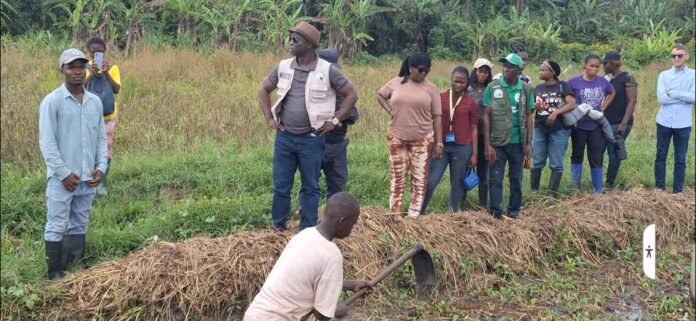

MONROVIA, LIBERIA-Agriculture Minister Alexander Nuetah is leading a five-day assessment in Bong County, as part of efforts to ensure the government’s funds are properly used to improve food production in Liberia.
According to Minister Nuetah, the assessment is to ensure donors’ funds make the desired impacts in the lives of farmers, and to get firsthand information on areas that need improvement.
In a release, the agriculture minister expressed strong approval in Bong County for the level of work done in maintaining its historical reputation as one of Liberia’s breadbasket counties.
He said while it is true that some communities still face productivity challenges, the collaboration observed in Zota and Panta Districts cannot be overemphasized.
Meanwhile, Minister Nuetah reaffirmed the Ministry’s unwavering commitment to scaling these gains nationwide to ensure Liberia achieves lasting food security.
In Bong County alone, Building Climate Resilience for Food Security (BCRP) is cultivating 400 hectares of rice, with prospects for further expansion based on continuing assessments and farmer readiness.
Additional gains are being driven by innovative community-led initiatives such as the Panta Pride Group, which is helping to mobilize and motivate smallholder farmers.
“As I walked through their paddy fields, I was surprised to see 100 acres developed on a fully mechanized scale—the first I have seen in recent times,” the agriculture minister disclosed
“I also visited a 30-hectare field in Gbarnga-Siaquelleh and several demonstration sites. They are doing well, and we want to see this replicated across other areas,” he added.
Dr. Nuetah linked these local achievements to broader national trends that indicate significant progress toward reducing Liberia’s reliance on imported rice.
The Liberian Agriculture Minister referenced a ‘May’ assessment supported by the Gates Foundation, which showed that 49% of the rice consumed in Liberia last year was produced locally, placing the country on a clear trajectory toward its goal of reducing rice imports by 70% by 2029.
Minister Nuetah further noted that a World Bank report released in late October confirmed an upward trajectory in national rice production in 2024, with even stronger gains projected for 2026.
“Some of our farmers are surpassing expectations and increasing productivity at encouraging rates,” he said. “We hope others will take inspiration from these examples and double up,” he revealed.